What is Electroplating? A Complete Beginner's Guide
Electroplating is one of the most widely used surface finishing techniques in manufacturing, yet most people only know it by its results — shiny chrome bumpers or corrosion-resistant fasteners. Here's what it actually is, how it works, and why it matters.
Sunsai Electroplating Team
Industrial Surface Finishing Specialists
In This Article
If you've ever picked up a chrome-plated wrench, a gold-plated connector, or a galvanized steel bracket, you've held electroplating in your hands without necessarily knowing it. It's one of the oldest industrial processes still in daily use, and it quietly touches almost every manufactured product you own.
This guide breaks down what electroplating actually is, how the process works at a chemical level, the main types used in industry today, and where you'll find it applied. No prior knowledge assumed.
What is electroplating? (Simple definition)
Electroplating is a process that uses an electric current to coat a conductive object with a thin layer of metal. The goal is usually to improve corrosion resistance, wear resistance, conductivity, or appearance without changing the base part's shape or dimensions significantly.
In plain terms: you take a part (called the substrate), dip it in a chemical solution containing dissolved metal ions, pass an electric current through it, and metal atoms bond to the part's surface one microscopic layer at a time.
Electroplating is different from painting or powder coating. It creates a metallurgical bond between the coating and the base metal rather than sitting on top as a separate film.
- Substrate — the part being plated (steel, brass, aluminium, plastic with a conductive coating, etc.)
- Electrolyte — a chemical bath containing dissolved metal salts
- Anode — usually a bar or pellets of the plating metal itself
- Cathode — the part being plated, connected to the negative terminal
- Power source — a rectifier supplying direct current (DC)
A brief history of electroplating
Electroplating traces back to the early 1800s, shortly after Alessandro Volta invented the electrochemical battery. Italian chemist Luigi Brugnatelli is credited with the first documented gold electroplating experiment in 1805, using a voltaic pile to deposit gold onto silver medals.
The process became commercially viable in the 1840s when British inventors George and Henry Elkington patented practical electroplating methods for gold and silver. From there, industrial applications expanded rapidly — first for decorative silverware, then for functional engineering coatings like nickel and chrome once electrical generators made large-scale plating economical in the late 19th and early 20th centuries.
Today, electroplating supports industries that didn't exist when the process was invented — electronics, aerospace, automotive manufacturing, and medical devices all depend on it.
The core electrochemistry hasn't changed much since the 1840s. What has changed is precision: modern rectifiers can hold current output steady within a fraction of a percent, and automated bath monitoring keeps chemistry within tight tolerances that early platers could only achieve through trial and error.
How does electroplating actually work?
Electroplating relies on a chemistry principle called electrodeposition. The part to be plated is connected to the negative terminal of a DC power source, making it the cathode. A bar or pellets of the plating metal is connected to the positive terminal, making it the anode.
Both are submerged in an electrolyte solution containing dissolved metal ions of the coating metal — for example, nickel sulfate for nickel plating, or copper sulfate for copper plating. When current flows, positively charged metal ions in the solution are attracted to the negatively charged part and deposit onto its surface as a solid metal layer.
At the same time, the anode slowly dissolves, releasing fresh metal ions into the solution to replace the ones deposited on the part. This keeps the electrolyte's metal concentration relatively stable during a production run.
"Electroplating is essentially controlled corrosion in reverse — instead of metal dissolving away, it's being deposited exactly where you want it, atom by atom."
— Sunsai Electroplating Team
Two variables control how the coating turns out: current density and time. Current density — the amount of current per unit of surface area — determines how fast metal deposits and how fine-grained the resulting layer is. Too high a current density produces rough, burnt deposits; too low produces a dull, thin layer that takes far longer to build up.
Plating time, combined with current density, determines final thickness. A thin decorative gold flash might only need a few seconds of plating time, while a thick hard chrome coating on a hydraulic rod can take several hours to build up the required thickness.
The electroplating process, step by step
A production-quality electroplating job involves far more than dipping a part in a tank. Surface preparation and post-treatment typically take up more time than the plating step itself.
- Cleaning — removing oils, grease, and dirt with alkaline or solvent cleaners
- Rinsing — removing residual cleaning chemicals to prevent contamination of later baths
- Surface activation/etching — removing oxide layers so the coating can bond properly
- Rinsing again — a second rinse to prevent drag-in of activation chemicals
- Electroplating — the part is submerged in the electrolyte and current is applied for a set time
- Rinsing — removing residual plating chemicals
- Post-treatment — passivation, sealing, or chromate conversion depending on the coating
- Drying and inspection — checking thickness, adhesion, and appearance
Skipping or rushing the cleaning and activation steps is the single biggest cause of plating adhesion failure — even a well-run plating bath can't compensate for a poorly prepared surface.
On a typical production run, cleaning and preparation can take longer than the plating step itself, especially for parts with oil residue from machining or forming. Skipping straight to the plating tank without proper preparation is one of the fastest ways to end up with peeling or blistering coatings later.
Key components of an electroplating setup
Every electroplating line, whether it's a small barrel-plating operation or a large rack-plating facility, is built around the same core components.
| Component | Function |
|---|---|
| Rectifier | Converts AC mains power into controlled DC current for plating |
| Plating tank | Holds the electrolyte solution and submerged parts |
| Anodes | Supply metal ions to the bath and complete the electrical circuit |
| Racks or barrels | Hold and electrically connect parts during plating |
| Filtration system | Removes particulate contamination from the bath |
| Heating/cooling system | Keeps the electrolyte within its optimal temperature range |
Small or delicate parts are often plated in rotating barrels, which tumble hundreds of components at once. Larger or more precision-sensitive parts are hung individually on racks, giving tighter control over coating thickness and uniformity.
Common types of electroplating
The plating metal you choose depends entirely on what the part needs to do. Here are the most common types used in industry.
Zinc plating
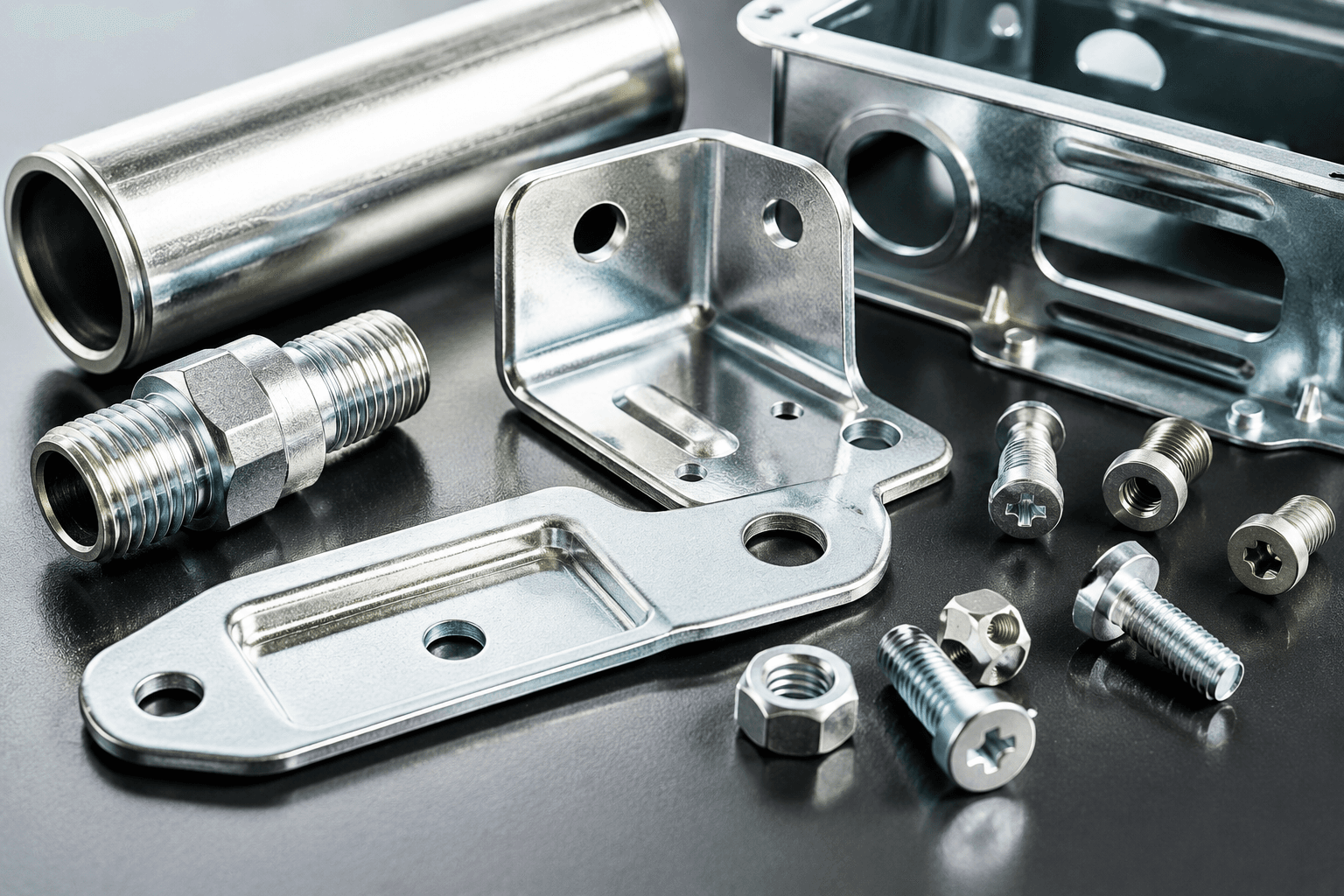
Zinc plating is a sacrificial coating — it corrodes before the underlying steel does, protecting fasteners, brackets, and automotive parts at a relatively low cost.
Nickel plating
Nickel plating offers strong corrosion resistance and a bright, attractive finish. It's frequently used as an undercoat before chrome plating.
Chrome plating
Chrome plating comes in two forms: decorative chrome, valued for its mirror-bright appearance on automotive trim and fixtures, and hard chrome, valued for extreme wear resistance on hydraulic cylinders and industrial shafts.
Copper plating
Copper plating provides excellent electrical conductivity and is commonly used as a base layer to improve adhesion for later coatings on difficult substrates like zinc die-castings.
Tin plating
Tin plating is solderable, non-toxic, and corrosion resistant, making it a standard choice for electrical connectors and food-contact components.
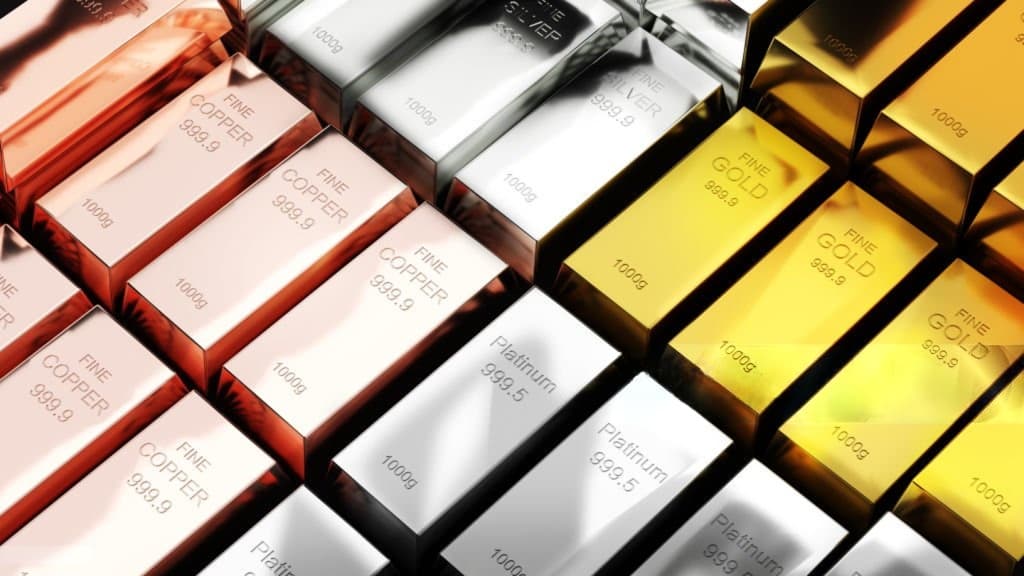
Gold and silver plating
Gold and silver plating are used where high conductivity, low contact resistance, or tarnish resistance matter most — think connector pins, printed circuit boards, and high-end decorative hardware.
Electroless plating
Not all metal plating uses electric current directly. Electroless plating relies on a chemical reducing agent instead of an outside power source to deposit metal, most commonly nickel. It's the technique used to make non-conductive materials like plastic platable, since it doesn't require the part to already carry current.
Electroless nickel also produces a more uniform coating thickness on complex geometries than standard electroplating, since it doesn't depend on current distribution across the part's surface. The tradeoff is a slower deposition rate and typically higher cost per part.
Electroplating vs anodizing vs powder coating
Electroplating is often confused with other surface finishing methods. They solve similar problems but work in fundamentally different ways.
| Process | How it works | Best suited for |
|---|---|---|
| Electroplating | Deposits a metal layer using electric current in a chemical bath | Metal substrates needing conductivity, wear resistance, or a metallic finish |
| Anodizing | Electrochemically thickens the natural oxide layer on aluminium | Aluminium parts needing hardness and corrosion resistance |
| Powder coating | Applies dry powder electrostatically, then cures it with heat | Parts needing a thick, colorful, non-metallic protective finish |
Anodizing only works on aluminium (and a few other non-ferrous metals) and produces a ceramic-like oxide layer, not a metal coating. Powder coating works on most substrates but produces a polymer finish rather than a metallurgically bonded metal layer. Electroplating remains the go-to option when you specifically need a metal-on-metal bond.
Where is electroplating used?
Electroplating shows up across nearly every manufacturing sector, often in places you wouldn't immediately notice.
- Automotive — bumpers, trim, wheels, fasteners, and engine components
- Electronics — connector pins, PCB traces, EMI shielding
- Aerospace — landing gear components, hydraulic actuators (hard chrome)
- Medical devices — surgical instruments, implantable component housings
- Consumer goods — bathroom fixtures, jewelry, kitchenware
- Industrial machinery — hydraulic rods, molds, wear-prone tooling
In each case, the choice of plating metal reflects the failure mode the part needs to resist — corrosion, wear, poor conductivity, or simply an unattractive finish.
Take a hydraulic cylinder rod as an example. It needs to resist constant sliding friction against a seal, exposure to hydraulic fluid, and occasional outdoor moisture. Hard chrome plating is specified here because it combines high surface hardness with good corrosion resistance — a combination that plain steel or a decorative coating simply can't match.
Compare that to a smartphone charging connector, which needs almost the opposite properties: low electrical resistance, resistance to tarnishing from repeated air exposure, and enough hardness to survive thousands of insertion cycles. That's why gold plating over a nickel underlayer is the industry standard for connector pins rather than chrome.
Benefits of electroplating
- Improved corrosion resistance, extending part lifespan in harsh environments
- Increased surface hardness and wear resistance
- Better electrical conductivity for connectors and contacts
- Enhanced solderability for electronic assembly
- Attractive, uniform, high-gloss finishes for consumer-facing parts
- Cost-effective compared to using a solid precious or specialty metal throughout the part
Because electroplating only applies a thin coating, it lets manufacturers get the performance benefits of an expensive metal — like gold's conductivity — while using only a fraction of the material a solid part would require.
This material efficiency is a big part of why electroplating remains competitive against alternative finishing methods even as raw material costs fluctuate. A connector pin needs only a few microns of gold to perform reliably, not a solid gold construction.
Common mistakes and quality problems
Most plating quality complaints trace back to a small handful of root causes. Knowing them helps you ask the right questions when evaluating a plating vendor.
- Poor surface preparation — leftover oils or oxide layers prevent proper adhesion
- Incorrect current density — causes uneven thickness, burning, or dull deposits
- Contaminated electrolyte — introduces pitting, roughness, or discoloration
- Hydrogen embrittlement — untreated high-strength steel parts can become brittle after plating and need a post-plating bake
- Inadequate rinsing between steps — drags contaminants from one bath into the next
- Wrong coating thickness for the application — under-specifying for the environment shortens service life
Hydrogen embrittlement deserves special attention because it's not visible on inspection. During plating, hydrogen atoms can diffuse into high-strength steel and make it brittle under load, sometimes causing delayed cracking hours or days after plating. Aerospace and fastener specifications typically require a post-plating bake at a controlled temperature within a set time window to drive the hydrogen back out.
A qualified plating partner will control these variables through documented process parameters, regular bath analysis, and thickness testing rather than relying on visual inspection alone.
Choosing the right electroplating partner
Electroplating looks simple from the outside, but consistent, defect-free results depend on tightly controlled chemistry, current, temperature, and timing. Small variations in any of these produce coatings that look fine initially but fail early in service.
When evaluating a plating vendor, ask about their process control documentation, thickness testing methods, and experience with your specific substrate and application. A good partner will also ask about your part's operating environment before recommending a coating — not just quote whatever you initially requested.
Whether you're specifying a coating for the first time or troubleshooting a recurring plating failure, understanding these fundamentals gives you a much stronger starting point for a conversation with your plating supplier.
Frequently Asked Questions
References
Need Professional Electroplating Services?
Contact our team for expert guidance and a free quotation.