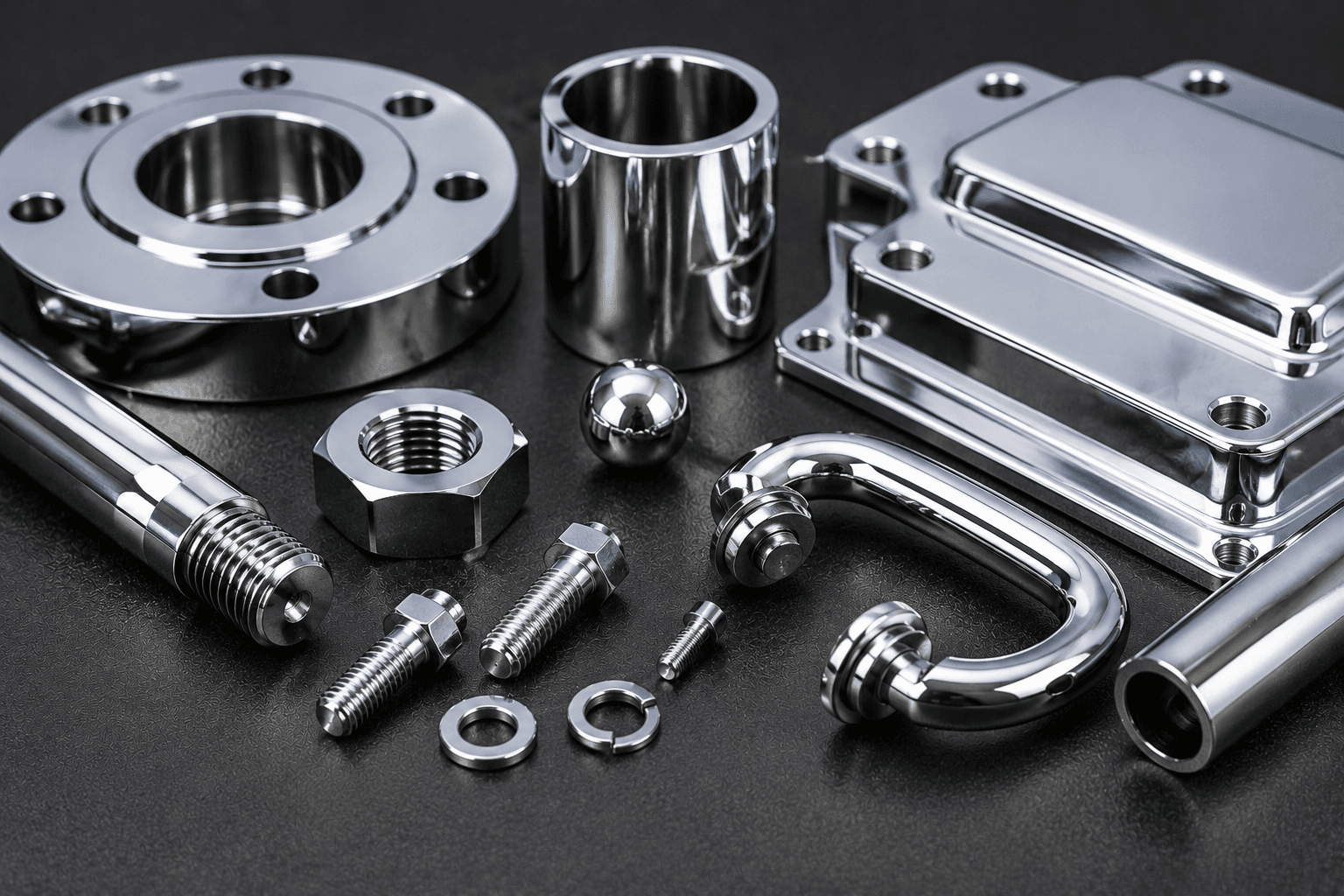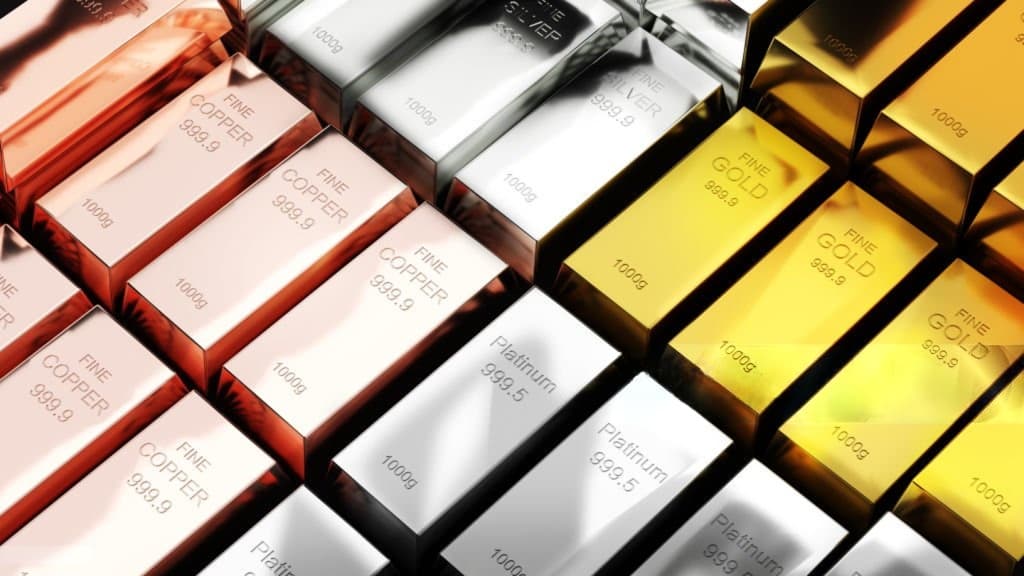
Decorative Chrome vs Hard Chrome Plating: Key Differences Explained
"Chrome plating" isn't one process — it's two, built for completely different jobs. Decorative chrome is about appearance and light corrosion protection over a nickel undercoat. Hard chrome is a thick, functional coating built to survive friction, load, and wear. Mixing the two up leads to parts that fail early or cost far more than they needed to.
Sunsai Electroplating Team
Industrial Surface Finishing Specialists
In This Article
Ask for a "chrome plating quote" and you might get two very different answers depending on who you're talking to — because chrome plating isn't a single process. Decorative chrome and hard chrome share the same base metal (chromium) but are built with different thicknesses, different underlying layers, and completely different jobs to do. Specifying the wrong one either wastes money on capability you don't need, or leaves a part that fails under load far sooner than it should.
Chrome plating is actually two different processes
Both processes use chromium deposited through electroplating, and both start from the same basic chemistry — a chromic acid bath and a controlled electric current. Past that, they diverge almost completely. Decorative chrome is a thin, cosmetic topcoat applied over a nickel undercoat. Hard chrome is a thick, standalone functional coating applied directly onto the base metal, with no nickel layer involved at all.
If a coating is described only as "chrome plating" with no further detail, it's almost always decorative chrome — hard chrome is typically specified explicitly because it's chosen for engineering reasons, not appearance.
What is decorative chrome plating?
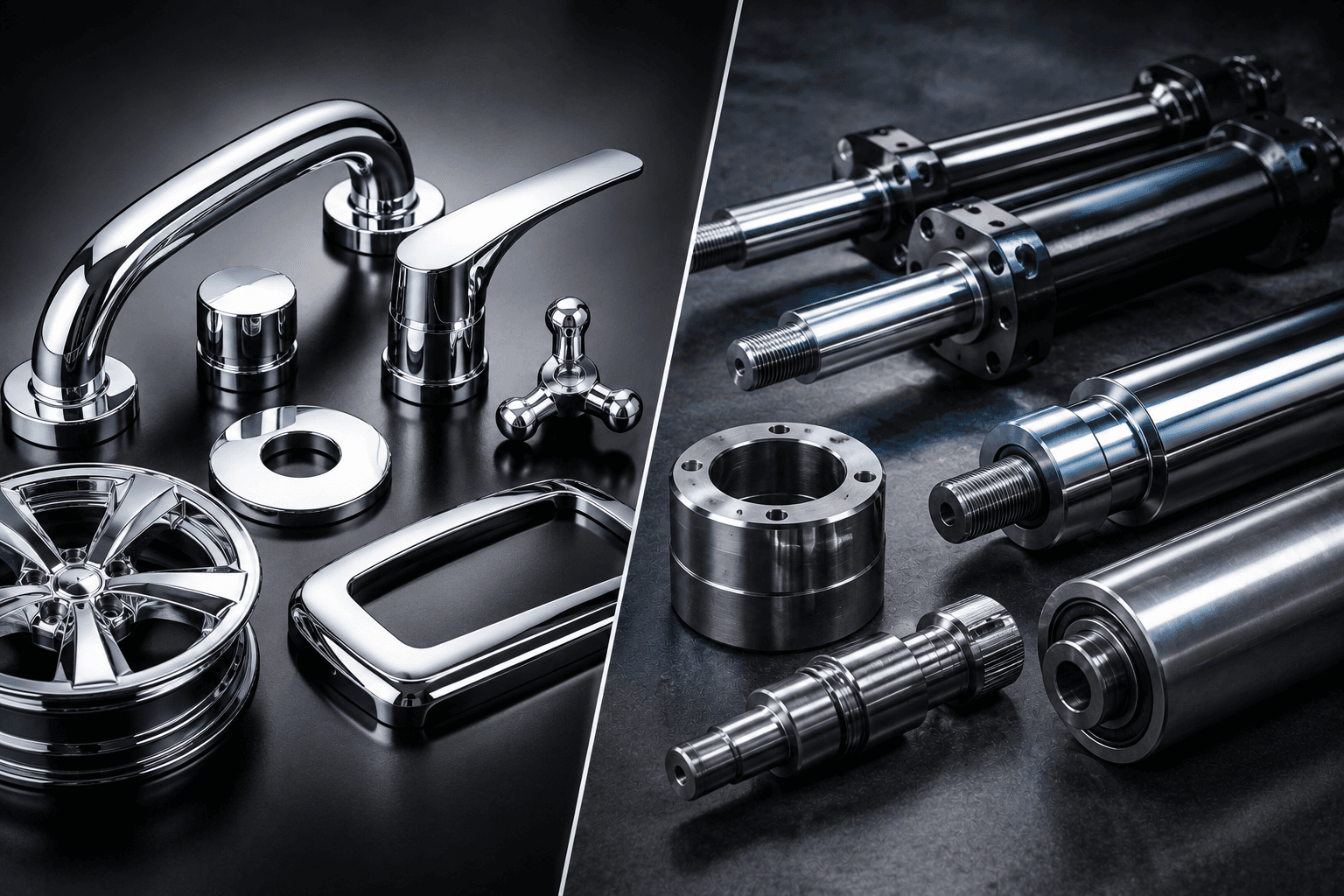
Decorative chrome is a thin chromium flash — typically well under a micron — applied on top of a bright nickel undercoat. The nickel layer underneath does almost all the corrosion-resisting and surface-leveling work; the chrome on top exists to add brightness, a cooler blue-white tone, hardness against light scratching, and resistance to tarnishing. This is the finish behind automotive trim, bathroom fittings, and furniture hardware — the shiny, mirror-like surfaces people picture when they hear "chrome."
Because the chrome layer itself is so thin, decorative chrome is not a wear-resistant coating on its own. Its durability depends heavily on the nickel undercoat beneath it, which is why decorative chrome is essentially never applied without nickel first — a topic covered in more depth in our nickel chrome plating guide.
What is hard chrome plating?
Hard chrome (also called industrial or engineering chrome) is a much thicker chromium deposit, applied directly onto the base metal with no nickel layer beneath it. Where decorative chrome measures in fractions of a micron, hard chrome is typically applied at tens to hundreds of microns thick. Its purpose isn't appearance — it's engineering performance: extreme surface hardness, resistance to abrasive wear, a low coefficient of friction, and the ability to restore worn dimensions on parts that have degraded through use.
Hard chrome coatings commonly reach hardness values in the range of 65–70 HRC, well above most tool steels, which is why it's the standard choice for surfaces that experience constant sliding friction or repeated mechanical loading.
- Hydraulic and pneumatic cylinder rods
- Piston rings and plunger pumps
- Rolls used in printing, textile, and steel processing
- Molds and dies subject to repeated wear
- Shafts and bearings in industrial machinery
Key differences at a glance
| Factor | Decorative Chrome | Hard Chrome |
|---|---|---|
| Primary purpose | Appearance, brightness, light corrosion resistance | Wear resistance, hardness, friction reduction, dimensional restoration |
| Underlying layer | Always applied over bright nickel | Applied directly onto base metal, no nickel |
| Typical thickness | 0.1 – 0.5 µm chrome flash | 25 – 250+ µm chrome |
| Surface hardness | Moderate (from the nickel + thin chrome) | Very high, typically 65–70 HRC |
| Typical parts | Automotive trim, taps, furniture hardware | Hydraulic rods, rollers, molds, industrial shafts |
| Cost driver | Nickel layer thickness and surface polish quality | Chrome deposit thickness and plating time |
Why chrome plating transforms durability and appearance
Whichever type is used, the transformation from raw, untreated metal to a finished chrome surface is dramatic — and it's not just cosmetic. An unplated steel or brass part is vulnerable to surface oxidation, scratching, and in the case of untreated ferrous metal, visible rusting within days of exposure to moisture. Chrome plating changes the surface at a microscopic level, replacing a reactive, easily damaged surface with a hard, chemically stable one.
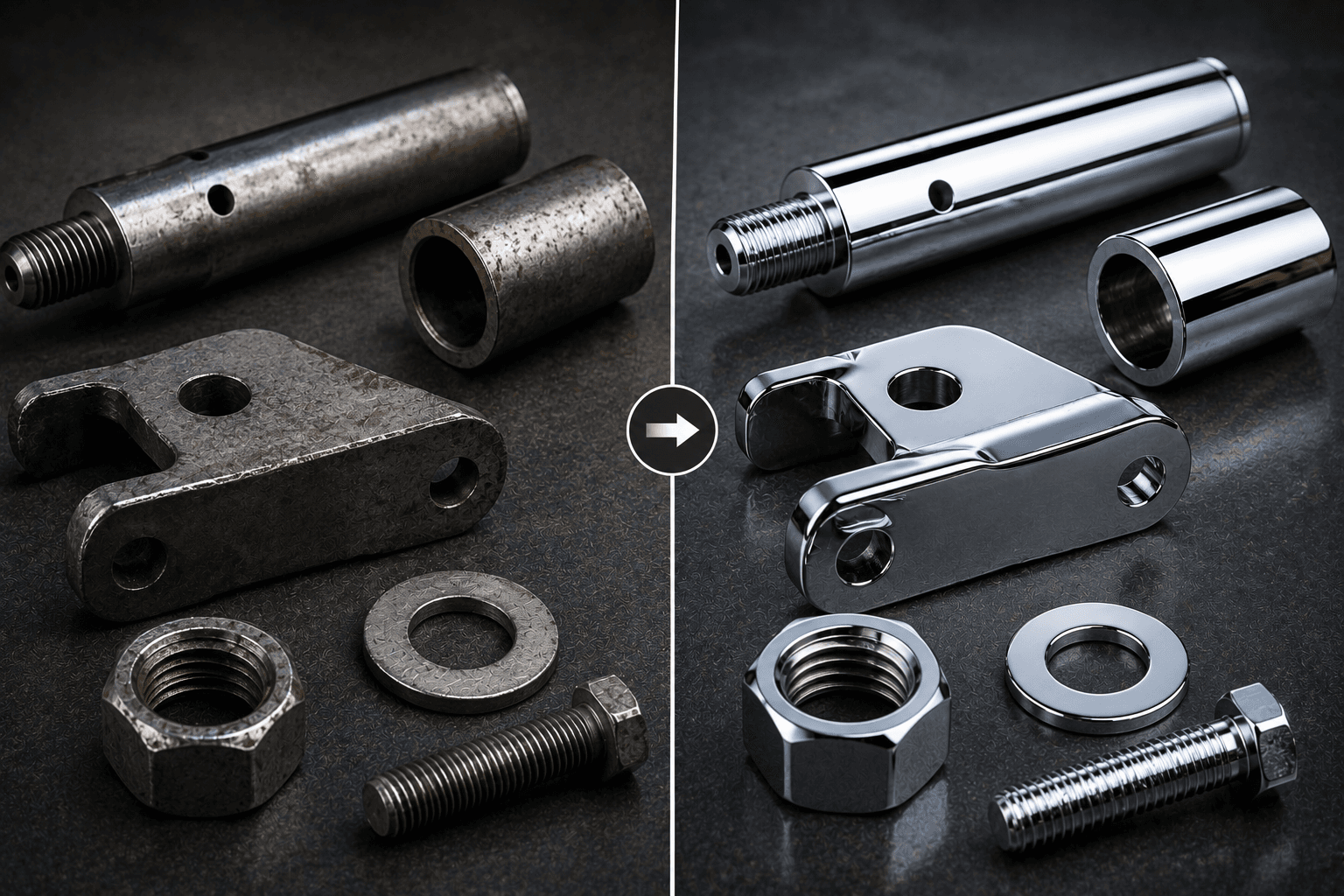
For decorative applications, this shows up as a surface that resists fingerprint corrosion, tarnishing, and UV yellowing for years, instead of dulling within months. For functional hard chrome applications, the same underlying chemistry produces a surface that can resist abrasive wear that would grind down bare steel in a fraction of the time, extending component service life significantly.
Thickness comparison
Thickness is the single biggest practical difference between the two, and it's worth understanding because it directly affects both cost and what the coating is actually capable of.
| Coating | Typical thickness range | What it's built for |
|---|---|---|
| Decorative chrome flash | 0.1 – 0.5 µm | Shine, tarnish resistance, light scratch resistance |
| Bright nickel undercoat (below decorative chrome) | 5 – 25 µm | Corrosion resistance, surface leveling |
| Hard chrome (functional) | 25 – 250+ µm | Wear resistance, friction reduction, dimensional buildup |
Hard chrome can be over 500 times thicker than a decorative chrome flash layer — which is why the two processes are priced, timed, and specified so differently, even though both are technically "chrome plating."
Where each type is used
The applications rarely overlap, because the requirements they solve for are so different.
- Decorative chrome — automotive bumpers and trim, bathroom fixtures, door and furniture hardware, motorcycle accessories, consumer product housings
- Hard chrome — hydraulic and pneumatic cylinder rods, industrial rollers, extrusion dies, injection molds, pump shafts, worn part reconditioning
One useful exception worth knowing: hard chrome is sometimes used specifically to restore an undersized worn part back to its original dimension before precision grinding, a repair application decorative chrome could never serve given how thin it is.
Which one does your part actually need?
The decision usually comes down to one question: does this part need to look good, or does it need to survive mechanical wear? If the part is customer-facing, handled, or purely cosmetic, decorative chrome over nickel is almost always the right (and far more cost-effective) choice. If the part experiences sliding contact, repeated friction, or heavy mechanical load — like a cylinder rod or a mold cavity — hard chrome is the only one of the two that will actually hold up.
- Choose decorative chrome if the part is seen, handled, or needs a premium appearance with moderate corrosion resistance
- Choose hard chrome if the part experiences friction, wear, sliding contact, or needs dimensional restoration
- Never substitute one for the other to save cost — a decorative flash won't survive mechanical wear, and hard chrome on a cosmetic part is an unnecessary expense
A good plating vendor should ask what the part actually does in service before quoting "chrome plating" — the right process depends entirely on whether the coating needs to look right or hold up under load, and those two jobs call for genuinely different coatings.
Frequently Asked Questions
References
Not Sure Which Chrome Finish You Need?
Tell us about your part and its operating environment, and we'll recommend the right chrome process for the job.